
Lane County Release Paths
Lane County Adult Corrections calls the Main Jail its adult intake and release center. It holds both pretrial adults and people serving local sentences. A recorded release can therefore mean return to the community on security, recognizance, dismissal, sentence completion, or a court order. It can also mean transfer to the Oregon Department of Corrections, another jail, an alternative-custody placement, federal authorities, or immigration custody. The destination field is as important as the word "release."
The Lane County AIC Viewer shows people currently lodged at the county jail. Lane deliberately removed past lodgings from that public view. When a name vanishes, the viewer establishes only that the person is not returned as currently lodged. It does not establish the exit time, authority, or destination. Those facts belong in the Adult Corrections movement or release record. A receiving agency may hold the next part of the history.
Facility identity comes first. Lane's Main Jail is the only county jail described as holding felony-level defendants and offenders. Springfield operates a separate municipal misdemeanor jail. The DOMC, electronic monitoring, and Residential Reentry Center are local alternatives where a person may remain under correctional control. Youth detention uses a protected process. A search in the wrong system can create a false impression even when every portal works as designed.
- Release
- The end of one custodian's control, which may be community exit or transfer.
- Time served
- A sentence credit or completion term, not the processed jail exit time.
- Discharge
- The end of a custody or supervision obligation identified by the responsible agency.
- Detainer
- A request by another authority for notice or continued custody so that authority may act.
Lane County Inmate Release Types
Release codes must be read in the context of the Lane case. A pretrial exit does not finish the prosecution. A transfer ends Lane County custody but starts or continues custody elsewhere. Probation, parole, or post-prison supervision may begin after physical confinement ends. These common outcomes should never be assigned to a person until the actual record supports them.
| Release type | What it means | Where to verify next |
|---|---|---|
| Security or bond | The person leaves jail while the case continues under court conditions. | Lane movement record and charging court |
| Recognizance | A court permits release without posting the ordered security. | Court order and Adult Corrections record |
| Time served or sentence end | The local custody part may end while another case or supervision remains. | Judgment, jail record, and supervision office |
| Alternative custody | The person may leave the building but remain in a Lane correctional program. | Program, Parole and Probation, and case record |
| Transfer | Another county, ODOC, federal authority, or ICE assumes control. | Lane destination entry and receiving system |
A dismissal may remove the basis for one charge, but another hold can still control. Death is also a possible custody-ending event and should never be grouped casually with ordinary community release. Use the exact language supplied by the custodian.
Transfers require a two-sided check. A Lane record may name ODOC, another county, Springfield, a treatment or alternative-custody placement, a federal authority, or ICE as the destination. The receiving system then shows whether custody continued. When the destination is blank or withheld, ask Adult Corrections for the releasable movement fields and the statutory basis for any redaction instead of treating the gap as proof of community release.
Lane County Release Record Fields
A useful Lane County release record answers who left, which custodian ended control, when the event occurred, and what followed. Ask for stable identifiers because names alone can collide. Admission and release timestamps define the lodging interval. The authority, type, and destination distinguish community exit from transfer. Charges and case numbers tie the movement to the correct court matter.
| Field | What it shows |
|---|---|
| Full name and AIC or booking number | The identity tied to the Lane lodging |
| Admission date and time | When Adult Corrections began that lodging |
| Release date and time | When Lane processed the end of its control |
| Release authority or type | The stated basis for the custody event |
| Charge and case references | The court matters associated with the lodging |
| Bail or security disposition | How a pretrial release condition was handled |
| Destination or receiving agency | Whether the person went to the community or another custodian |
The court judgment explains legal authority, but it is not a live movement log. An order may be entered before jail staff finish release processing. Transport can follow the end of one custodian's control. Oregon corrections and notification feeds update on separate cycles. Preserve each label and source when dates differ.
For a pretrial release, the security disposition and releasing authority help explain why the person could leave before the case ended. For a sentence, the judgment and time-credit record explain the legal term, while the movement record supplies the actual processed exit. For a transfer, the destination or receiving-agency field is the key safeguard against mislabeling continued custody as freedom. A certified copy or written custodian response is stronger than a saved public-screen image when the precise event matters.
Request Lane County Release Records
Use the Lane County jail and AIC records page for county adult material. A request can go through the linked online portal, be delivered at the Jail Records window, or be mailed using the county form. Give the full name, date of birth or AIC identifier if known, and an approximate lodging date. Narrow requests let staff locate the right event and separate releasable fields from protected material.
- Identify the exact lodging with the name, identifier, booking range, and facility.
- Ask for admission and release timestamps, release code or authority, and destination or receiving agency.
- Choose the county portal, Jail Records window, or mail route. Ask for electronic delivery and a cost estimate.
- If information is withheld, ask for the exemption and any segregable, nonexempt portion.
- Match the movement entry to the court register and any receiving-system record.
The Sheriff's fee schedule lists separate prices for AIC history, arrest reports, comprehensive files, photographs when lawfully disclosable, and extra pages. Charges can also reflect compilation or redaction. Check the current schedule when filing. Lane gives no instant or fixed completion promise for a jail request.
101 W. 5th Avenue
Eugene, OR 97401
Jail information: 541-682-4263
Online disappearance does not mean the file was destroyed. Oregon's county retention schedule sets minimum periods of twenty years for homicide booking records, ten years for felonies, and five years for misdemeanors. A granted set-aside can change lawful public visibility. Juvenile files follow separate confidentiality and expunction rules.
State-prison history uses a different custodian. ODOC accepts requests through its Public Records Center or by mail. A release-focused request can identify the SID, name, birth date, and date range, then seek admission, actual release, release type, final computation, projected-date history, release authorization, and parole or post-prison discharge. State clerical, managerial, professional, copying, archive, legal, and redaction costs may apply. Ask for an estimate and specify whether certification is needed.
Oregon Law on Lane Releases
ORS 192.311 through 192.478 provides Oregon's public-records framework. It supports access to nonexempt public records, agency response duties, and reasonable cost recovery. It does not make every jail field public. Privacy, safety, active-investigation, sealed-case, juvenile, and criminal-justice restrictions may require redaction or withholding.
A court order under ORS chapter 137 may seal qualifying arrest or conviction records. Never infer that relief from a blank search result. The court record controls what can lawfully be confirmed.
Current ORS 133.870 provides limited booking-photo disclosure routes, including access by the depicted person and other defined recipients or circumstances. Lane County makes the restriction clear on its jail records page. ORS 133.875 and ORS 646A.806 address qualifying removal duties for publish-for-pay arrest-photo services, but third-party image availability does not prove that the Sheriff may release a photo now. A booking photo is not the release record itself.
Lane Bond Release Is Not Disposition
The Main Jail holds pretrial adults as well as sentenced people. A security, bond, or recognizance release ends present confinement, not the prosecution. The charging court may still impose appearance dates, release conditions, or later case events. Pair the jail exit with the correct Lane court register before calling the sentence complete.
Eugene's municipal bail instructions show why the distinction matters. Payment may be accepted for Eugene municipal charges through specified channels while the court is closed, and the receipt states the court date and whether an appearance is required. The city's general processing estimate applies only after completed papers reach the jail. It is not proof of one person's exit and not a countywide promise.
The charging court also depends on jurisdiction. Lane Circuit Court is not automatically the record holder for every municipal lodging. Eugene, Springfield, Cottage Grove, Florence, Junction City, Coburg, Oakridge, and Lane Justice Court maintain their own case routes for matters they handle. Follow the case number and charging court shown in the jail material. A release from one case does not cancel a warrant or hold in another.
Note: Another hold can keep a person in custody even when one Lane County charge permits release.
Find a Released Lane Inmate
Start with the system that last held the person. The county AIC Viewer and Springfield Web Jail Viewer answer present-custody questions for different facilities. Neither is a historical countywide release list. VISOR can supply a custody event or alert. Oregon Offender Search can reveal a transfer to state custody or active community supervision. Court records explain release authority and later case action. A final county confirmation comes from the jail movement record.
- Search the Lane AIC Viewer and record the check time. Search Springfield separately when municipal lodging is possible.
- Search Oregon VISOR using an exact or partial name, SID, or County ID. Read release and transfer events literally.
- Check Oregon Offender Search for an ODOC transfer, prison status, or community-corrections status.
- Review the correct court register for the security order, dismissal, judgment, sentence, warrant, or set-aside entry.
- Use BOP or ICE only when the case or Lane destination points to a federal or immigration system.
- Request the Lane or Springfield release movement. Ask for release type and destination.
For a same-day inquiry, the Lane County 24-hour release list method explains how to define and request an exact interval when no public feed exists.
Federal and immigration searches need their own identifiers. BOP accepts federal register, DCDC, FBI, or INS numbers, plus a name search with optional descriptors. ICE ODLS accepts a padded nine-digit A-number with country of birth or exact biographical details. A federal pretrial defendant may never appear in BOP because the U.S. Marshals Service uses contract facilities. In that situation, use the federal case, arresting or holding facility movement, and Marshals or court contact.
ODOC Released Offender Search
The Oregon Offender Search applies to people who entered ODOC custody or remain under local Community Corrections. It is not an archive of every Lane County booking. SID is the most precise input. Name fields accept wildcards, while multiple filled fields combine and may over-narrow a search. Compare the identifier before opening a record.
| Field | How to use it |
|---|---|
| SID | Use the exact state identifier; wildcards do not apply. |
| Name | Try the legal name, aliases, and supported wildcard syntax. |
| Status and location | Distinguish prison confinement from Community Corrections. |
| Projected Release Date | Treat it as an estimate, not a completed release. |
| Supervising office | Identify post-prison supervision after physical release. |
Someone who fully discharged may no longer appear. Request historic fields through the ODOC Public Records Center.
The official ODOC search screen separates the state search from the county jail record.
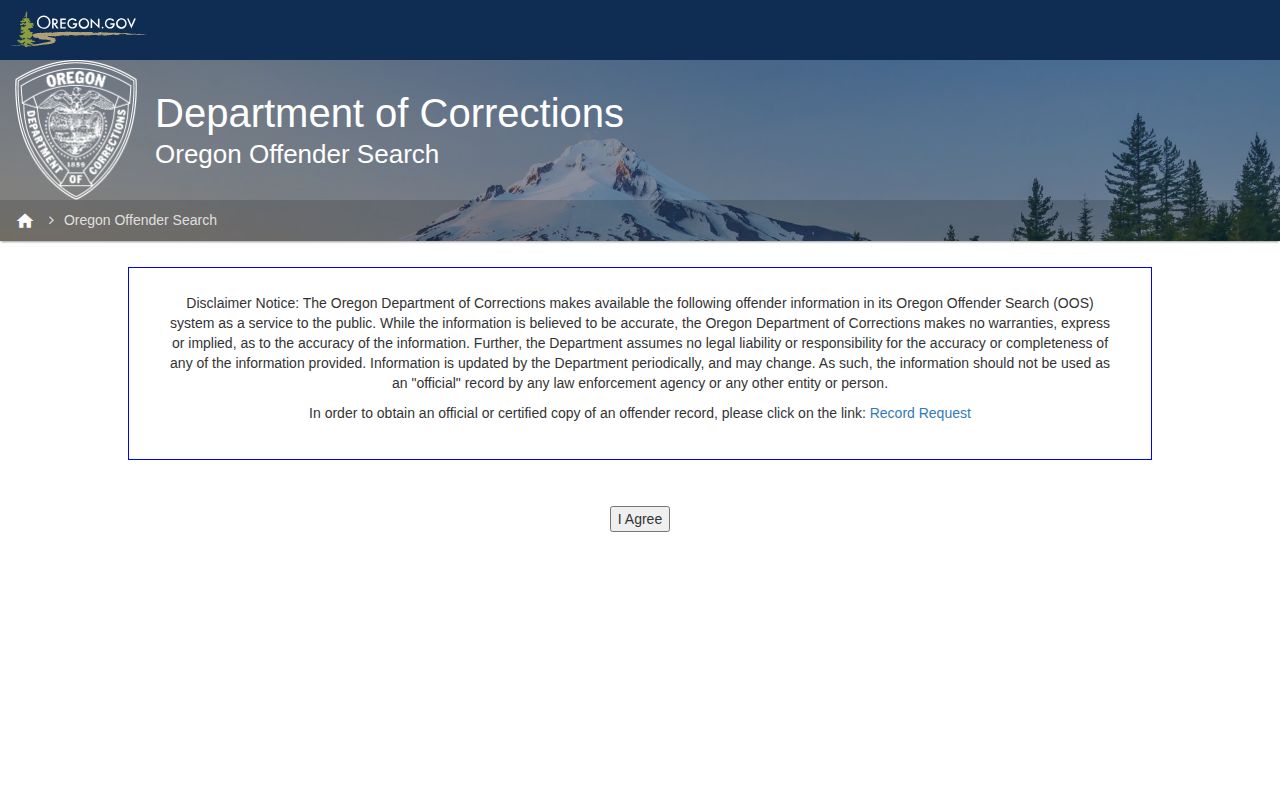
A state result can confirm a transfer or supervision status, but the Lane record remains the source for the county exit.
ODOC warns that displayed offenses relate to the current incarceration, not a lifetime criminal or custody history. Check the Names tab because an alias can match even when the heading uses the court name. Note the public data timestamp, current location, and supervising county. A Community Corrections location can mean prison confinement ended while post-prison control continues. If the public result is absent after full discharge, the official-record request is the historic fallback.
Lane County Recent Release Lookup
Lane County does not publish a separately identified official rolling twenty-four-hour or seventy-two-hour release feed in the reviewed jail navigation. The current AIC Viewer cannot be repackaged as either list. Define the desired interval in local time, note exact start and end timestamps, and request the Adult Corrections movement extract for that period.
Springfield maintains a separate municipal jail and present-custody viewer. A person absent from Lane's viewer could be held there. A person leaving Springfield with a felony or other hold could later appear at Main Jail. Search both viewers when jurisdiction is unclear, then request the correct jail's record.
For a recent interval, ask for a releasable extract containing the name, AIC or booking number, booking time, release time, release authority or reason, case or charge reference, and destination. Booking photos should not be presumed part of the response. Lane's underlying booking records remain subject to retention schedules even though past lodgings have zero post-exit visibility in the public viewer. Web retention and agency retention are different questions.
Note: No official Lane sheriff jail app was found for recent releases or booking photos, so do not substitute an unrelated app.
Lane Release Into Supervision
Lane County Parole and Probation supervises adults assigned locally after jail or prison. Physical release can start probation, parole, or post-prison supervision. No public Lane P&P person search or absconder list was found. Confirm the office and status through the local agency, subject to disclosure limits, and use the court judgment or Board order for the legal basis.
A supervision entry does not prove the jail exit timestamp. It shows the relationship that followed. Custody for a violation also does not always end the supervision term.
Lane P&P is the local contact when Oregon Offender Search identifies Lane as the supervising county. If supervision transferred to another state, Oregon's Interstate Compact information and the ICOTS public portal provide a separate lead. Interstate transfer changes the supervising location, not the original release date. A Board hearing or projected parole date is also not an accomplished release; use the written order and later custody movement.
Lane Custody Continues Outside Jail
Lane's corrections system includes the Community Corrections Center or DOMC, electronic monitoring, work crew, community service, and the Residential Reentry Center. These programs create a local custody-to-supervision continuum. Someone may be outside the Main Jail building for approved activity while correctional control or a sentence remains in force.
The Community Corrections Center uses a structured residential placement with approved absences. Electronic monitoring changes how custody is served. The RRC supports controlled transition for sentenced participants. Program entry is not necessarily discharge, and completion may still lead into probation, parole, or post-prison supervision. Verify each stage with the program, Lane P&P, and the court case.
Note: Physical presence in the community and legal discharge are separate facts in Lane County's alternative-custody system.
Three Lane Release Records Compared
Lane Adult Corrections, the charging court, and the next correctional agency answer different questions. The jail movement record establishes the physical event. The court register and judgment explain the legal reason. ODOC or Lane P&P shows later custody or supervision. A strong release check reconciles all three rather than forcing one source to answer every question.
Read a court register in time order: arrest and arraignment, security and release conditions, charging action, plea or trial result, judgment, sentence, then later warrant or supervision events. The Oregon free Online Records Search provides a register of actions, not all filed documents. Confidential, sealed, juvenile, and other protected matters may not appear.
Lane Circuit Court copies can be requested online, by email to its copy unit, or through the Archives Department. Copies cannot be ordered by telephone. Supply the case number, party names, and an approximate date. Court staff may need several business days to respond and longer to complete some requests. The free register can cap broad results, while OJCIN OnLine and courthouse terminals offer other public-access routes. None of them replaces the Sheriff's processed release timestamp.
No. It may explain why one case no longer supports custody. Adult Corrections still records when processing ended, and another hold may control.
Lane Release Alerts and Federal Records
Oregon uses VISOR for custody checks and automatic notice of release or transfer events in county and state systems. Search by full or partial name, SID, or County ID. A result may show status, custody-status date, state or local numbers, an earliest release date, and facility information. Read each label exactly. VISOR is periodically updated and is not a certified release record.
The BOP Inmate Locator covers federal prison records from 1982 forward and may show a release date with "Released" or "Not in BOP Custody." That status does not rule out another system or federal supervised release. Federal pretrial custody is different. Use the federal court docket, holding facility, and U.S. Marshals route rather than expecting a full BOP history.
These systems do not replace each other. VISOR covers Lane and Oregon custody. BOP covers federal prison. ICE has its own locator. The Lane movement record remains the starting point when a local lodging ends.
The Oregon public Sex Offender Registry is narrower still. It covers qualifying registrants under its public rules and is not a general release index. Absence cannot establish incarceration, release, conviction history, or the absence of a nonpublic registration duty. Use it only for the limited status the official registry is designed to provide.
Lane Release to ICE Custody
An ICE transfer is not community release. ICE describes a detainer as a request for notice and up to forty-eight additional hours of custody so federal immigration authorities may assume control. A Lane release-to-ICE entry proves that county control ended. It does not prove that the person went home or was removed from the country.
Search the ICE Online Detainee Locator System using a nine-digit A-number and country of birth, or exact biographical details. ICE says ODLS includes current detainees and people released from ICE custody within the prior sixty days. Obtain the Lane destination entry and relevant ICE record rather than guessing from roster absence.
A detainer is a request, not proof that ICE actually assumed custody. The Lane movement and destination fields should show what happened. Even when ODLS finds the person, do not infer deportation or final immigration disposition from detention status alone.
Lane Release Status by System
The right tool depends on both the custodian and the question. Current rosters show present confinement. Movement and discharge files establish history. Notification systems can flag events, but they should be corroborated. The table keeps those functions separate.
| System | Best question answered | Release caution |
|---|---|---|
| Lane AIC Viewer | Is the person currently shown in Main Jail? | A negative result is not proof of release. |
| Lane Adult Corrections record | When and why did the county lodging end? | Read the destination to detect transfer. |
| Springfield records | Was the person in the separate municipal jail? | Use municipal records for its history. |
| Oregon Offender Search | Did ODOC custody or supervision follow? | Projected dates and actual release differ. |
| VISOR | Did a county or state event post? | An alert is not a certified record. |
| BOP or ICE | Did a federal system hold the person? | Each locator has a defined scope. |
Lane Capacity Release History
Lane County says a 2013 levy reopened jail bed areas and led to fewer capacity-based releases. That history explains why an older Lane record may contain a local release category that cannot be understood from today's viewer alone. It does not show that any named person received a capacity release. Only the person's release record can support that claim.
The Main Jail was built in 1979, expanded in 1988 and 1999, and has a reported capacity of 411 beds. Those facts provide context, not a formula for release. Court orders, sentence status, alternative programs, holds, and available bed space can relate to custody movement in different ways.
Lane's current capital planning also discusses possible jail changes. Planning documents do not prove a change in present release practice. Historical and current claims must stay tied to the period and source that supports them.
Lane County Release Facilities
Lane County has six facility or program paths in the research map. Each requires its own confirmation route. Adult county records belong with Adult Corrections. Springfield uses a city system. Alternative-custody placements require program and supervision checks. Youth detention is confidential and separate from the adult viewer.
- Main Jail: county adult intake and release center; use the AIC movement record.
- Community Corrections Center / DOMC: structured residential placement; verify program and supervision status.
- Electronic Monitoring: being outside the building can remain alternative custody.
- Residential Reentry Center: controlled transition may precede final discharge.
- Springfield Municipal Jail: separate city misdemeanor jail with its own records.
- Juvenile Detention Center: protected youth system using Youth Services channels.
No ODOC prison, BOP institution, or dedicated ICE detention center is physically listed in Lane County. Lane residents can still transfer to those systems elsewhere.
The Main Jail is the first county custodian for adult felony-level lodging and county intake. The Community Corrections Center or DOMC is a structured residential placement with approved absences, so a person may look physically free while a local program still controls movement. Electronic monitoring likewise moves custody outside a cell without necessarily ending the sentence. The Residential Reentry Center is a controlled transition program adjacent to the Main Jail, and continued contact with parole or probation may be part of that path.
Springfield Municipal Jail handles a distinct city misdemeanor population and runs its own Web Jail Viewer. A release record from Springfield should be requested from the municipal jail or police records route and read with the Springfield Municipal Court case. The Lane County Juvenile Detention Center at the John Serbu Youth Campus serves a protected youth process. Adult search methods, public release windows, and adult records forms do not carry over to that facility.
Lane Juvenile Release Is Separate
Lane County Youth Services says detention staff may release a youth to a parent, guardian, responsible adult, or on recognizance, or retain the youth for court. These events do not belong in the adult AIC Viewer. Juvenile confidentiality also makes a public recent-release list inappropriate.
Use Lane County Youth Services and the juvenile court function when disclosure is authorized. The county process may require a signed, notarized juvenile-record release form. An adult jail request cannot bypass those rules.
Release to a parent, guardian, responsible adult, or on recognizance describes who receives the youth or the legal basis for leaving detention. It does not create a public adult-style history. Court participation may continue after a youth leaves the campus. Families and authorized parties should use Youth Services contacts and the permitted juvenile court route, while members of the public must respect the confidentiality boundary.
The distinction protects both accuracy and lawful access. A blank adult viewer result says nothing about whether a youth was detained, released, or retained for court. It also should never be filled with data from an unofficial source. The agency and court will determine what can be disclosed to an authorized requester.