
Lane Main Jail Release Role
The Lane County Corrections Division identifies the Main Jail as the county's adult intake and release center. It receives adults before trial as well as sentenced adults who are not suited to a lower-cost alternative program. A physical exit may follow a court-ordered recognizance release, posted security or bond, dismissal, sentence completion, or another order. The same exit door may also mark a transfer. ODOC, another jail, a treatment placement, federal custody, immigration custody, electronic monitoring, or a residential program may take over control.
That range of outcomes makes the destination field as important as the release time. A movement entry that says transfer does not prove the person returned to the community. Likewise, a person who posts security has left the jail while the criminal case continues. The sheriff's record documents the physical Lane County movement, while the charging court explains the legal order. ODOC or Lane County Parole and Probation may show what came next.
Confirm Lane Main Jail Release
Begin with the official Lane County AIC Viewer. It is a present-custody check, not a historical release index. Record the exact spelling, any known AIC or booking number, and the time of the check. If the person appears, read the listed custody location, charges, security information, and case references. If no result appears, do not label the person released yet. A transfer, data delay, confidentiality rule, spelling issue, or another custody system can also explain the absence.
A disciplined release check uses the systems in sequence:
- Search the AIC Viewer with the full legal name and any known identifier.
- Check Oregon VISOR for a custody status or transfer event involving the same identity.
- Search Oregon Offender Search if the jail movement may have led to state custody or community supervision.
- Review the proper court register for the release order, judgment, dismissal, sentence, or later warrant.
- Request the Adult Corrections movement and release record, including release authority and destination.
The strongest answer pairs the outgoing Lane record with the incoming system when there was a transfer. For a named-person workflow and a fuller explanation of each search channel, use the Lane County released-inmate search and records coverage.
Note: A future projected release date, an earliest release date, and an accomplished Main Jail release are three different facts.
Lane Main Jail Release Record
The Jail Information and AIC Records page is the official access route after a person drops from the live viewer. A focused request should identify the adult by full name, date of birth or AIC number when known, and an approximate booking date. Ask for the admission and release movement rather than an open-ended file if the goal is only to confirm exit.
Useful record fields include:
| Field | Why it matters |
|---|---|
| AIC or booking number | Separates people with similar names and ties the event to one lodging. |
| Admission date and time | Defines the start of the Main Jail custody episode. |
| Release date and time | Shows when Lane Adult Corrections processed the movement. |
| Release code or authority | Distinguishes security release, court order, sentence completion, and transfer. |
| Case and charge references | Connect the jail event to the right court matter. |
| Destination or receiving agency | Shows whether the person entered the community or another form of control. |
Lane lists an AIC history or dates-of-incarceration product, an arrest report, and a comprehensive file per lodging on its fee schedule. Additional pages may cost more. Fees and disclosure rules can change, so review the current Sheriff's Office fee schedule and ask for an estimate. A booking photograph is a separate record with special Oregon restrictions. It should not be assumed available because an AIC history is releasable.
Lane Main Jail Records Contact
Adult Corrections is the proper custodian for Main Jail admission, lodging, movement, and release material. Court staff hold the judgment and register. The two offices answer different questions. Ask the jail for the processed exit and its code. Ask the court for the order or disposition that supplied legal authority.
Lane County Adult Corrections Main Jail
101 W. 5th Avenue
Eugene, OR 97401
General information and Jail Reception: 541-682-4263
Use the official Jail Information and AIC Records page for the public-record form and current records instructions. Confirm reception access before traveling because posted schedules may change.
A clear request asks for releasable movement entries for one lodging, including admission time, release time, release code or authority, and destination. Request an electronic copy and a cost estimate. If any field is withheld, ask the custodian to identify the exemption and provide the segregable public portion under Oregon Public Records Law.
Lane Main Jail Custody Facts
Lane County reports that the Main Jail was built in 1979 and expanded in 1988 and 1999. Its stated capacity is 411 beds. Those facts describe the institution, not the status of any person. The operational point is more useful: this is Lane County's only jail able to hold felony-level defendants and offenders, and the county expressly calls it the intake and release center.
The jail holds both pretrial and sentenced adults. That mix means a single word such as “release” is not enough to describe the event. A pretrial release can return someone to the community under court conditions. A sentence completion may end the jail term but leave probation or another case active. A transfer can move the person straight into a different facility. Each conclusion should come from the record, not from the building's role alone.
The county's official description is preserved in the source capture.
View the Lane County Corrections Division source page.
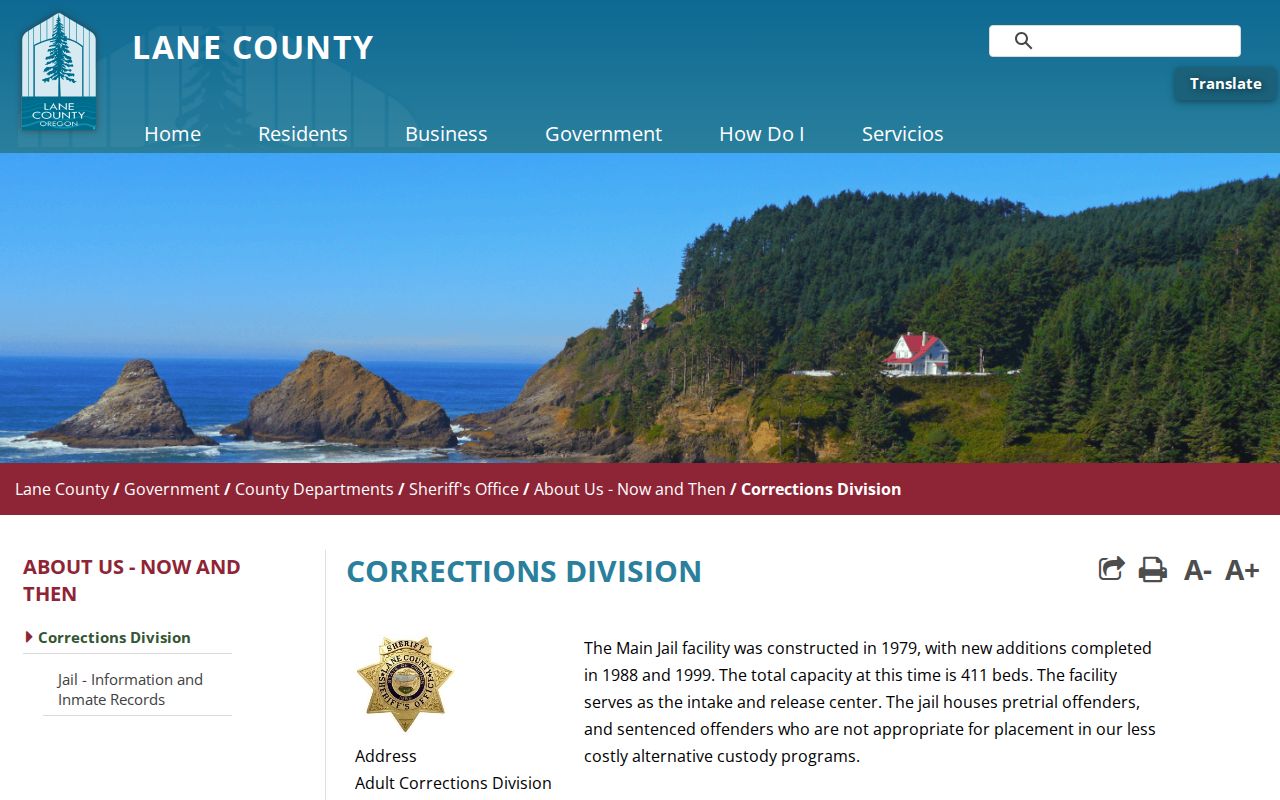
The source confirms why Adult Corrections is the first local source for a Main Jail release event.
Lane Main Jail Alternative Custody
Lane County operates a continuum beyond the Main Jail. The Community Corrections Center or DOMC provides structured residential placement with approved absences. The Residential Reentry Center supports controlled transition for sentenced participants. Electronic monitoring can place someone outside the jail building while sheriff control continues. Movement into one of these programs is best described as a custody-program change unless the later record also shows completion or discharge.
When a Main Jail record points to an alternative program, verify three separate dates: exit from the Main Jail, entry into the program, and completion or termination of that program. Then determine whether probation, parole, or post-prison supervision continues. Combining those events into one “release date” hides the exact legal status and can create a false claim of unconditional release.
- Alternative custody
- A court or corrections placement outside a standard secure jail unit while legal control continues.
- Discharge
- The end of the sentence or supervision component identified in the controlling record.
- Detainer
- A request or hold that may route a person to another authority instead of the community.
Note: A person seen in the community on approved activity may still be assigned to structured custody or active supervision.
Lane Main Jail ICE Transfers
An immigration detainer requires special care when reading a Lane County release record. ICE describes a detainer as a request for notice and custody for up to 48 hours beyond ordinary release so the Department of Homeland Security may assume custody. The request alone is not proof that ICE took the person. A Main Jail movement entry showing release to ICE proves the end of county control, but it does not prove release into the community.
Confirm the destination in the Adult Corrections record, then use the ICE Online Detainee Locator System. ODLS accepts an A-number and country of birth, or exact biographical details. ICE states that the system includes current detainees and people released from ICE custody during the prior 60 days. If no result appears, the time window, exact-name requirement, age limit, or data status may explain it. Do not infer deportation or community release from a blank result.
Lane Main Jail Release History
Lane County's history gives older release records important context. The county says a 2013 levy reopened jail bed areas that had been closed and led to fewer capacity-based releases. “Capacity release” is therefore a real local term that may appear in older discussion or records. It cannot be assigned to a particular person merely because the jail was crowded or because an online entry disappeared.
The release authority on the actual movement record controls. Older events also remain subject to retention schedules even though Lane removed past lodgings from its public viewer. Oregon's county records schedule sets minimum periods by the seriousness of the booking: 20 years for homicide, 10 years for felony, and five years for misdemeanor booking records. Web visibility can end at once while the agency file remains available for years.
Note: Historical jail policy provides context, but only the individual AIC record can identify a capacity-based release.
Public Record Search
Sponsored Results