
Lane County Projected vs Actual Release
Oregon Department of Corrections uses the term Projected Release Date, or PRD, for the anticipated completion of an incarceration term. OAR 291-100 governs ODOC admission, sentence computation, and release. A PRD reflects the information and credit assumptions in the computation at that point. It can change. The actual release is the later movement event showing that the named custodian ended physical control, transferred the person, or placed the person into another legal status.
Lane County Adult Corrections uses its own jail and movement records. A court judgment may establish the sentence, but the judgment is not a live movement log. Credit already served, another case, a sanction, or a hold can affect the processed exit. For a pretrial detainee, there may be no computed sentence-release date at all. Bail, recognizance, dismissal, a court order, or continued detention may control the next step.
Scheduled vs actual: A projected date is an estimate tied to sentence administration; only a later custody or movement record confirms what happened.
The destination matters too. A Lane jail release entry may mean community release, transfer to ODOC, movement to another jurisdiction, or placement in a local alternative-custody program. It should not be shortened to “went home” without the release type and destination.
Find a Lane County Projected Date
Begin by identifying the sentence and custodian. Oregon Offender Search is for people in ODOC custody or active local Community Corrections coverage, not every booking at Lane County Adult Corrections. The Lane jail record is the proper source for a local jail computation and processed movement. The charging court record explains the sentence and later changes.
- Obtain the judgment and list each term, offense date, credit-for-time-served provision, and whether terms run at the same time or one after another.
- For an ODOC sentence, search the full legal name or SID in Oregon Offender Search. Compare identifiers before opening a record.
- Read the live field label exactly. Do not rename earliest release, PRD, sentence expiration, parole date, or discharge as though they were one event.
- For a Lane jail sentence, use the Adult Corrections records route to request the calculated date and supporting movement fields, and ask what judgment and credits were used.
- Check the Lane Circuit Court records process or correct municipal court register for an amended judgment, warrant, dismissal, release order, or later case.
- After the projected date passes, confirm the actual release or transfer through the originating custodian and any receiving system.
The broader Lane County released-inmate record process explains how to obtain the final movement entry when a date alone does not show whether release occurred.
Note: Multiple uncertain search fields can hide an ODOC match, so start with SID or exact name and remove guesses.
Oregon Earned Time for Lane Sentences
Oregon does not use a generic rule that every person serves 85 percent of a sentence. For an eligible felony term tied to a crime committed on or after November 1, 1989, ORS 421.121 allows a reduction of up to 20 percent for qualifying conduct and adult-basic-skills participation. The statute also prevents that reduction from bringing actual confinement below six months. “Up to” is critical because eligibility, performance, exclusions, and later changes are individual.
The maximum reduction can resemble an 80 percent outcome for an eligible term. It is still not a formula a reader can safely apply to the pronounced sentence. ODOC computation may account for earned credits through the last review and project compliance for the balance. Credits can be granted, retracted, or restored. Consecutive terms, time-served corrections, another judgment, and sentence-law versions also affect the PRD.
Lane County jail credit requires a separate local computation. The research identifies conditional good-time or work credit in Lane work-crew materials, but it does not support a universal county percentage. Ask Adult Corrections for the releasable computation and the court judgment on which it rests.
Good-time rule: Eligible ODOC terms may receive up to 20 percent earned time, but no fixed percentage applies to every Oregon or Lane County sentence.
Why Lane County Release Dates Change
A PRD changes when the facts used in sentence administration change. Movement can be earlier, later, or directed to a different custodian. A date change alone does not prove an agency error. The computation history and later movement record show the reason more reliably than an old screenshot.
| Factor | Possible effect | Record to check |
|---|---|---|
| Earned time | Grant, retraction, or restoration can alter an eligible ODOC PRD. | ODOC computation and PRD history |
| Judgment change | An amended term or corrected credit can change the calculation. | Court judgment and ODOC or jail recalculation |
| Concurrent or consecutive terms | The order in which terms run changes the total incarceration period. | Judgment and official computation sheet |
| Detainer or other sentence | The person may transfer instead of entering the community. | Movement destination and receiving-system record |
| Board decision | For a board-jurisdiction case, an order may set, affirm, defer, or postpone a date. | Written BOPPPS order |
| Program or conduct status | Eligibility or compliance changes may affect projected credit. | ODOC sentence and earned-time records |
A projected date can also coexist with parole or PPS planning. Leaving an institution may begin supervision rather than end all control. If the record shows a field office or supervising county, verify that assignment with Lane County Parole and Probation.
Confirm Lane County Actual Release
VISOR can add a timely custody-status or event notice for a specific person in an Oregon county or state facility. Its detail may show an Earliest Release Date and a Custody Status Date. Neither label should be silently converted into the actual release. VISOR is periodically updated and is not the certified record.
For a pending event, register through the correct person record and choose the available release or transfer notice. The Lane County VINELink and VISOR check gives the current Oregon procedure. After an alert arrives, corroborate the event with Lane Adult Corrections for a county-jail case or with ODOC for a prison case.
A released status should be paired with the facility, date or time shown, and destination if available. A transfer notice means the sending custodian changed. It does not necessarily mean the person entered the community. If the receiving system is another county, federal custody, or immigration custody, continue there.
Note: Preserve each system's date label because earliest release, custody-status date, PRD, and actual release answer different questions.
Lane County Measure 11 Dates
Measure 11 follows a stricter rule than ordinary eligible earned time. Under ORS 137.700, the listed mandatory minimum must be served in full. Earned time, temporary leave, and post-prison release cannot shorten that mandatory-minimum period. It is a 100 percent minimum rule, not an 85 percent rule.
A sentence above the minimum needs its own analysis. The offense, offense date, exact judgment, and applicable version of Oregon law all matter. ORS 137.635 also requires the entire determinate sentence for specified repeat serious felonies and bars identified reduction, leave, and parole routes. A label such as “violent offense” is not enough to perform the computation.
The safe method is documentary: get the judgment, identify the statutory minimum for each count, determine whether terms run together or one after another, and obtain the agency's computation. Do not subtract a standard fraction. When the ODOC field changes, request the PRD history if the reason is important.
ODOC Dates for Lane County Cases
Oregon Offender Search can show current custody or community-corrections information, but it is not a full historic discharge index. SID is the most precise input. Name fields accept wildcard searches, and aliases may appear under the Names tab. The record can include status, institution or supervision location, court, current-incarceration offenses, and release-related fields.
| Search field | Use | Release-date caution |
|---|---|---|
| SID | Most precise Oregon state identifier; wildcards do not apply. | Match it before relying on any date. |
| Name | Exact names or supported wildcard forms can locate a result. | Check aliases and the court name to avoid a collision. |
| Status and location | Distinguishes institution from active community supervision. | A field office can mean prison release with supervision still active. |
| Release-related label | May identify PRD, earliest release, expiration, or another event. | Copy the label exactly and do not call it actual release. |
| Data timestamp | Shows when the public record was last updated. | A later official computation can supersede an older screen. |
The official ODOC search screen is the proper statewide starting point for a Lane County case that moved into state custody.
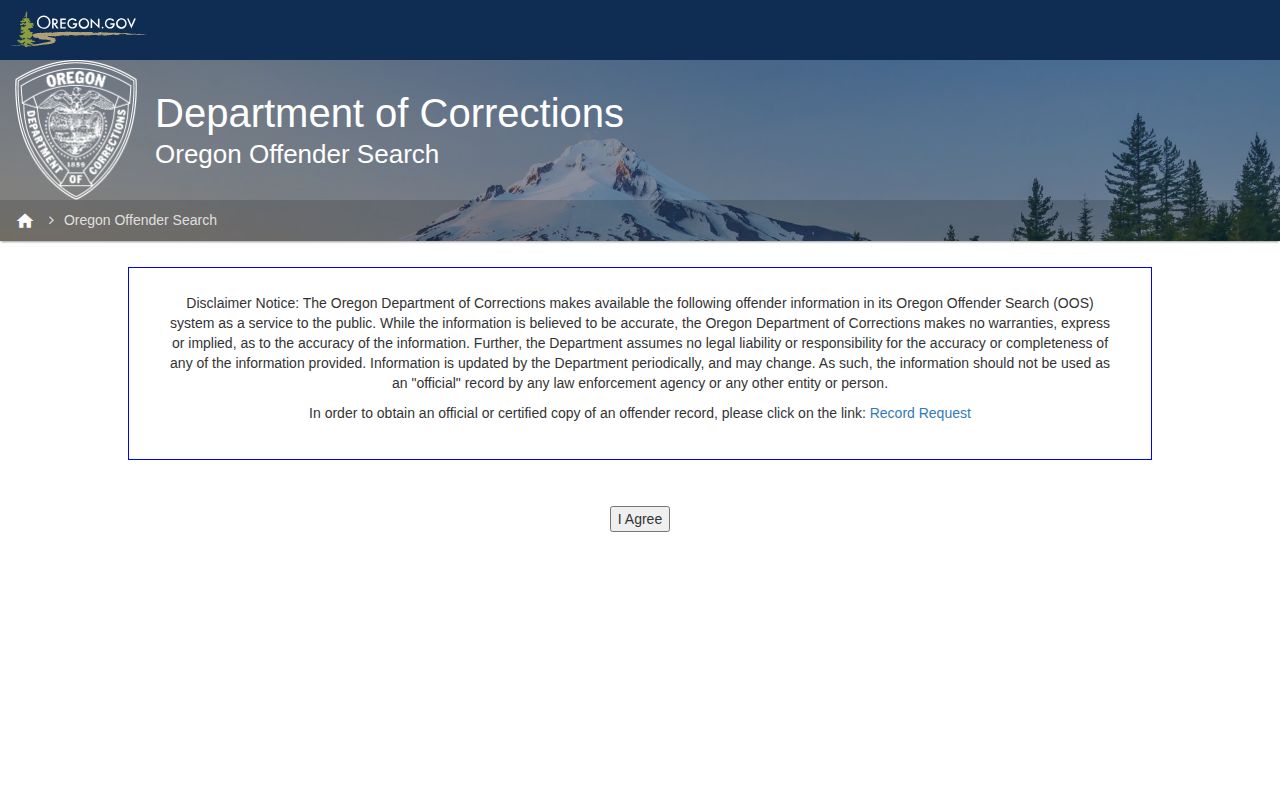
The search screen must be used with a known name or identifier, and any returned PRD remains prospective until a later status or movement record confirms release.
A person who fully discharged can disappear from the public OOS scope. For historic proof, submit a focused ODOC public-record request with the name, SID, date range, admission, actual release, release type, computation sheet, PRD history, and parole or PPS discharge fields needed. This is stronger than treating a blank result as proof of any event.
ODOC's Public Records Center can also supply an official or certified record when the public display is too thin. Request the first and last face sheets, final computation sheet, PRD history, release authorization, and actual release or transfer entry that answer the question. State whether certification is required and ask for an estimate before work begins. A public-search date and the later certified movement record may differ because they serve different purposes and update on different schedules.
Lane County Dates Before Discharge
Short-Term Transitional Leave shows why physical location and legal release are not the same. ODOC describes eligible people leaving physical custody 30, 60, 90, or 120 days early. That placement does not convert the PRD into an unconditional discharge date. The record should state the program and continuing authority.
Lane County's Residential Reentry Center, electronic monitoring, and alternative jail programs create a similar reading problem at the local level. A person may be outside the Main Jail while still in alternative custody or under a sentence. Program entry, program completion, release from the jail, and final discharge can occur on different dates.
A detainer can also redirect the event. Lane Adult Corrections or ODOC may end its control and transfer the person to another jurisdiction. Confirm the destination before describing that movement as community release. Where the person is on parole or PPS, the supervising office records the later community relationship.
Note: Transitional leave and Lane alternative custody can change physical placement without ending the underlying incarceration or supervision term.